Skip to main content
Contents Index Dark Mode Prev Up Next \( \DeclareMathOperator{\AVE}{AVE}
\DeclareMathOperator{\SUM}{SUM}
\DeclareMathOperator{\SD}{SD}
\DeclareMathOperator{\rms}{rms}
\DeclareMathOperator{\REGR}{REGR}
\DeclareMathOperator{\AND}{AND}
\DeclareMathOperator{\OR}{OR}
\DeclareMathOperator{\OPPOSITE}{OPPOSITE}
\DeclareMathOperator{\Inn}{Inn}
\DeclareMathOperator{\lcm}{lcm}
\DeclareMathOperator{\Aut}{Aut}
\DeclareMathOperator{\Perm}{Perm}
\DeclareMathOperator{\Stab}{Stab}
\DeclareMathOperator{\Orb}{Orb}
\DeclareMathOperator{\Rot}{Rot}
\DeclareMathOperator{\re}{Re}
\DeclareMathOperator{\im}{Im}
\DeclareMathOperator{\img}{image}
\DeclareMathOperator{\conj}{conj}
\DeclareMathOperator{\Id}{Id}
\newcommand{\C}{\mathbb{C}}
\newcommand{\Quat}{\mathbb{H}}
\newcommand{\extC}{\hat{\C}}
\newcommand{\R}{\mathbb{R}}
\newcommand{\extR}{\hat{\R}}
\newcommand{\F}{\mathbb{F}}
\newcommand{\extF}{\hat{\F}}
\newcommand{\Z}{\mathbb{Z}}
\newcommand{\Proj}{\mathbb{P}}
\newcommand{\Q}{\mathbb{Q}}
\newcommand{\M}{{\rm \bf M}}
\newcommand{\E}{{\rm \bf E}}
\renewcommand{\H}{{\rm \bf H}}
\newcommand{\HU}{\H_{\U}}
\renewcommand{\S}{{\rm \bf S}}
\newcommand{\D}{\mathbb{D}}
\newcommand{\closedD}{\hat{\D}}
\newcommand{\U}{\mathbb{U}}
\newcommand{\spacer}{\rule[0cm]{0cm}{0cm}}
\newcommand{\MOD}{\mathbin{\text{MOD}}}
\newcommand{\twotwo}[4]{\left[ \begin{array}{cc} #1 \amp #2 \\
#3 \amp #4 \end{array} \right]}
\newcommand{\lt}{<}
\newcommand{\gt}{>}
\newcommand{\amp}{&}
\definecolor{fillinmathshade}{gray}{0.9}
\newcommand{\fillinmath}[1]{\mathchoice{\colorbox{fillinmathshade}{$\displaystyle \phantom{\,#1\,}$}}{\colorbox{fillinmathshade}{$\textstyle \phantom{\,#1\,}$}}{\colorbox{fillinmathshade}{$\scriptstyle \phantom{\,#1\,}$}}{\colorbox{fillinmathshade}{$\scriptscriptstyle\phantom{\,#1\,}$}}}
\)
Section 1.5 Lines: Slope, Rise, and Run
Subsection 1.5.1 Basics for lines
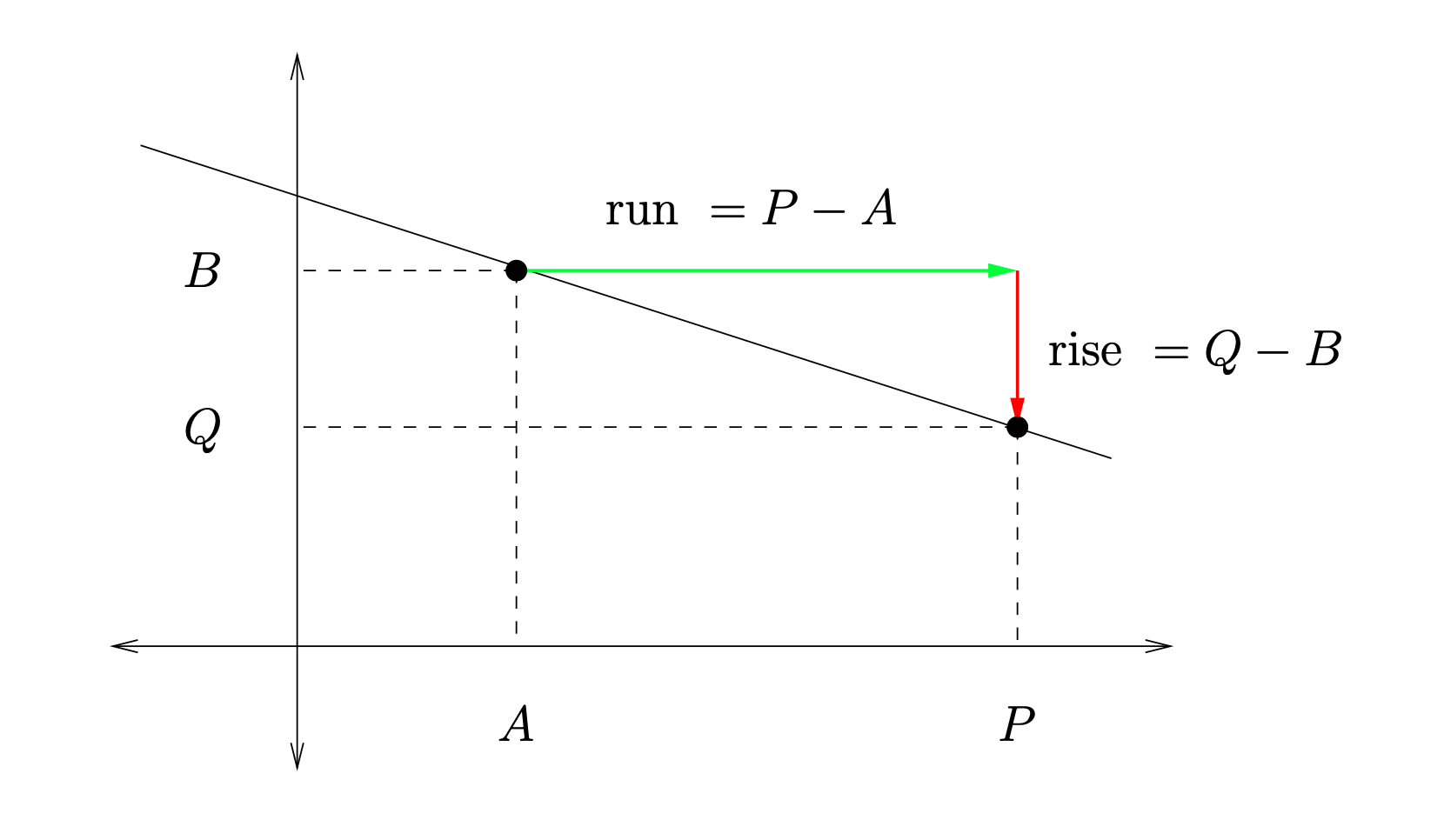
Let \(L\) be a line in the \(x,y\) -plane that is not vertical (that is, not parallel to the \(y\) -axis). Visualize traveling along the line \(L\) from a starting point \((A,B)\) to a final point \((P,Q)\text{.}\) From start to finish, your position along the \(x\) -axis will change from \(A\) to \(P\text{.}\) The deviation of \(P\) from \(A\) (also called the horizontal displacement from \((A,B)\) to \((P,Q)\) ) is called the run of your trip.
\begin{equation*}
\text{ run } = P-A
\end{equation*}
Likewise, your position along the
\(y\) -axis will change from
\(B\) to
\(Q\text{.}\) The deviation of
\(Q\) from
\(B\) (also called the
vertical displacement ) is called the
rise of your trip. See Figure
Figure 1.5.1 .
\begin{equation*}
\text{ rise } = Q-B
\end{equation*}
The fraction rise/run is called the slope of the line \(L\text{.}\)
\begin{equation}
\text{ slope } = \frac{ \text{ rise }}{\text{ run }}=\frac{Q-B}{P-A}\tag{1.5.1}
\end{equation}
\begin{equation*}
\text{ rise } = { \text{ (slope)}}{\text{(run) }}
\end{equation*}
and solving
(1.5.1) for
\(Q\text{,}\) we have
\begin{equation}
Q=\text{ (slope)(run)} + B = \text{ (slope)}(P-A)+B.\tag{1.5.2}
\end{equation}
Figure 1.5.1. Rise and run. Here is a basic problem involving lines: You are given a line
\(L\text{,}\) the slope
\(m\) of
\(L\text{,}\) a starting point
\((A,B)\) on
\(L\text{,}\) and the
\(x\) -coordinate
\(P\) of a final point
\((P,Q)\) on
\(L\text{.}\) Your task is to find
\(Q\text{.}\)
The solution uses
(1.5.2) broken into three these steps:
Find the run using \(\text{ run } = P-A\text{.}\)
Find the rise using \(\text{ rise } = \text{ (slope)(run)}\text{.}\)
Find \(Q\) using \(Q=\text{ rise } + B\text{.}\)
Exercises 1.5.2 Practice problems for lines
1.
Names of quantities in the top row of the table below match
Subsection 1.5.1 . Find the values of run, rise, and
\(Q\) for each row of the table.
\begin{align*}
A
\amp\spacer\amp B
\amp\spacer\amp
\text{slope}
\amp\spacer\amp P\\
\rule{.5in}{.1ex} \amp \amp \rule{.5in}{.1ex} \amp \amp
\rule{.5in}{.1ex} \amp \amp \rule{.5in}{.1ex}\\
20.13
\amp\spacer\amp 15.86
\amp\spacer\amp 1.10
\amp\spacer\amp 24.8\\
20.13
\amp\spacer\amp 15.86
\amp\spacer\amp 1.10
\amp\spacer\amp 17.5\\
103.20
\amp\spacer\amp 26.78
\amp\spacer\amp -0.65
\amp\spacer\amp 110.0\\
103.20
\amp\spacer\amp 26.78
\amp\spacer\amp -0.65
\amp\spacer\amp 95.0
\end{align*}
Answer .
\begin{align*}
A
\amp\spacer\amp B
\amp\spacer\amp
\text{slope}
\amp\spacer\amp P
\amp\spacer\amp \text{run}
\amp\spacer\amp \text{rise} \amp\spacer\amp Q\\
\rule{.5in}{.1ex}
\amp \amp \rule{.5in}{.1ex}
\amp \amp \rule{.5in}{.1ex}
\amp \amp \rule{.5in}{.1ex}
\amp \amp \rule{.5in}{.1ex}
\amp \amp \rule{.5in}{.1ex}
\amp \amp \rule{.5in}{.1ex} \\
20.13
\amp\spacer\amp 15.86
\amp\spacer\amp 1.1
\amp\spacer\amp 24.8
\amp\spacer\amp 4.67
\amp\spacer\amp 5.14
\amp\spacer\amp 21.00\\
20.13
\amp\spacer\amp 15.86
\amp\spacer\amp 1.1
\amp\spacer\amp 17.5
\amp\spacer\amp -2.63
\amp\spacer\amp -2.89
\amp\spacer\amp 12.97\\
103.20
\amp\spacer\amp 26.78
\amp\spacer\amp -0.65
\amp\spacer\amp 110.0
\amp\spacer\amp 6.80
\amp\spacer\amp -4.42
\amp\spacer\amp 22.36\\
103.20
\amp\spacer\amp 26.78
\amp\spacer\amp -0.65
\amp\spacer\amp 95.0
\amp\spacer\amp -8.20
\amp\spacer\amp 5.33
\amp\spacer\amp 32.11
\end{align*}